The Camper Van and the Local Economy: Traveling to Get to Know the Land
“In truth, I wasn’t born a camper van enthusiast; I became one over time,” says Massimo Acanfora, journalist, writer, and huge fan of camper van travel. “What I love about ‘dwelling while traveling’ is its essentiality, the search for intimacy with nature, and the (temporary) loss of one’s sedentary nature. Today, I move around in a ’94 LPG Volkswagen T4, full of patches—which, incidentally, human beings get at a certain age too. It has a name, like almost all camper vans: Van Basten, in honor of a football era that no longer exists.”
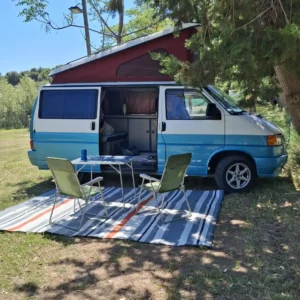
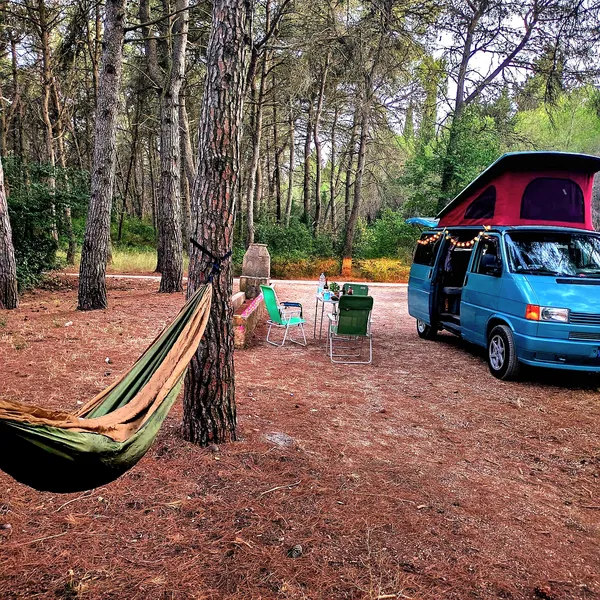
This image well captures the spirit of La felicità del camper (Camper Van Happiness), a book by Massimo Acanfora published by Altroconsumo: a philosophical and practical guide for free, ecological, slow travel. Not a perfect vehicle, nor a romanticized idea of the open road, but a different way of existing in places.
In Acanfora’s book, the camper van does not represent an escape from daily life. Rather, it is a tool that alters one’s relationship with time, consumption, and the land. It is a form of travel that favors observation over speed, and connection over simply passing through places.
In a region like Puglia, this approach takes on a special meaning.
Getting to Know the Land Instead of Just Passing Through It
Much of contemporary tourism is built around destinations. You reach a location, visit the most famous spots, take photos, and move on to the next stop.
The camper van introduces a different dynamic. The experience focuses not only on the destination, but on the journey itself. Secondary roads, inland villages, local markets, farms, and artisan workshops become an integral part of the trip.
In this sense, the traveler doesn’t just cross through a territory: they temporarily inhabit it.
Time and Consumption
One of the most interesting aspects of Acanfora’s reflection concerns the relationship between time and consumption. Organized tourism tends to minimize the time required to experience something. Traveling by camper van works in the opposite direction.
It requires stops, detours, unexpected events, and a certain willingness to change plans. This slowing down fosters encounters with economic activities that rarely find a place in faster-paced itineraries:
A small winery.
A farmers’ market.
An artisan workshop.
An olive oil mill open for tours.
These are realities that require time and attention, but allow for a much deeper understanding of the land.
Sobriety and Awareness
The theme of essentiality frequently emerges in the book. The limited space of a camper van naturally leads one to select only what is truly necessary.
This condition doesn’t apply only to physical objects; it also influences the way one consumes. Available resources are finite, spaces are small, and needs become simpler. There is a tendency to buy less and choose more carefully. Quality replaces quantity.
The relationship with the land changes as well. More attention is paid to what is used, what is left behind, and the impact of one’s choices.
Puglia as a Distributed Economy
Puglia possesses a characteristic that often escapes first-time visitors. Its identity is not concentrated in just a few main attractions; it is distributed.
It can be found in the small olive oil mills of Upper Salento, the wineries of the Itria Valley, the village bakeries of the Murge, the coastal fish markets, and the farms producing oil, wine, cheeses, and preserves. Many of these businesses remain outside the main tourist circuits.
Traveling by camper van—precisely because it is less bound to rigid itineraries—allows you to come into contact with this widespread network of activities that forms the economic and cultural backbone of the region.
The Zero-Kilometer Economy as a Travel Experience
The concept of “zero kilometer” (farm-to-table/locally sourced) is often associated exclusively with food. In reality, it is mostly about the relationship between the producer and the consumer.
When a traveler buys olive oil directly from a mill, cheese from a small dairy, or vegetables from a local grower, they aren’t simply purchasing a product. They are engaging with a story, a landscape, and a community. The purchase becomes a way of understanding the land.
Many of the flavors we remember after returning from a trip stem not just from the quality of the product itself, but from the experience accompanying it: a visit to a masseria (historic farmhouse), a conversation with the producer, or the discovery of a family tradition passed down through time.
A Tourism that Generates Local Value
The distribution of tourist flows represents one of the main challenges for many destinations. The most famous spots attract the vast majority of visitors, while vast inland areas remain on the sidelines.
Camper van travel can help rebalance this dynamic. Those who move slowly tend to stop in small towns, use local services, and engage with economic realities that rarely benefit from mass tourism.
For Puglia, this means enhancing not only its famous coasts and celebrated villages, but also its agricultural landscapes, historic masserie, local producers, and inland towns.
Another Way to Measure a Trip
The quality of a trip doesn’t necessarily depend on the number of places visited; it can depend on the ability to understand the land you pass through.
The philosophy described by Massimo Acanfora suggests precisely this shift in perspective. The camper van isn’t interesting because it lets you see more. It is interesting because, in some cases, it lets you see better—to dedicate time to lesser-known places, to support often-invisible local economies, and to build a more direct relationship with the landscape and the people who inhabit it.
In a region like Puglia, where richness is spread across countrysides, farmhouses, villages, and agricultural production, this approach is more than just a way to travel. It can also become a tool for understanding the land and the communities that bring it to life.
Because, in the end, the most important road isn’t the one crossing a region or a continent; it is the one leading us to rediscover a more authentic relationship with time, nature, and ourselves.
Want to experience this philosophy among the countryside, villages, and coasts of Puglia? Discover Calì, Cielo, and Faustino: our three Volkswagen Californias ready to take you wherever you wish.