Volkswagen Camper: The History, Generations, and the Legend That Keeps on Rolling
Some vehicles simply transport people. Others carry dreams.
The Volkswagen Camper undoubtedly belongs to the second category. For more than seventy years, it has represented far more than just a means of transportation. It has become a symbol of freedom, slow travel, adventure, and discovery. It has crossed generations, trends, and continents, earning its place as one of the world’s most recognizable automotive icons.
Even today, when people think of vanlife, they often picture a Volkswagen camper parked by the ocean, its pop-top roof raised and a surfboard resting nearby.
But how did this legend begin—and how has it evolved into the camper we know today?
An Idea Born After World War II
The story begins in 1947, when Ben Pon, Volkswagen’s Dutch importer, visited the company’s factory in Germany. There, he noticed simple utility vehicles being used to transport parts around the plant. Inspired by what he saw, he sketched a concept that would eventually change automotive history.
The idea was simple yet revolutionary: build a versatile, durable, and spacious vehicle capable of carrying goods during the week and taking families on weekend adventures.
In 1950, the first Volkswagen Transporter entered production.
No one could have imagined that this practical utility vehicle would become one of the greatest cultural icons of the twentieth century.
The Volkswagen Transporter Generations
T1 (1950–1967): The Birth of a Legend
The first Volkswagen Transporter, affectionately known as the T1, is instantly recognizable thanks to its split windshield, which earned it the nickname “Split Screen.”
Powered by the same rear-mounted engine as the Volkswagen Beetle, the T1 quickly gained popularity across Europe thanks to its simplicity, reliability, and versatility.
Among its most celebrated versions is the Samba Bus, famous for its panoramic windows and large fabric sunroof. Today, it remains one of Volkswagen’s most sought-after collector vehicles.
T2 (1967–1979): The Hippie Era
In 1967, Volkswagen introduced the T2.
Its one-piece panoramic windshield earned it the nickname “Bay Window.” Larger, more powerful, and more comfortable than its predecessor, the T2 became the ultimate symbol of the counterculture movement of the late 1960s and 1970s.
This was also the era when Westfalia camper conversions became incredibly popular. Pop-top roofs, compact kitchens, and fold-out beds transformed the Transporter into a true home on wheels.
T3 (1979–1992): More Space, More Comfort
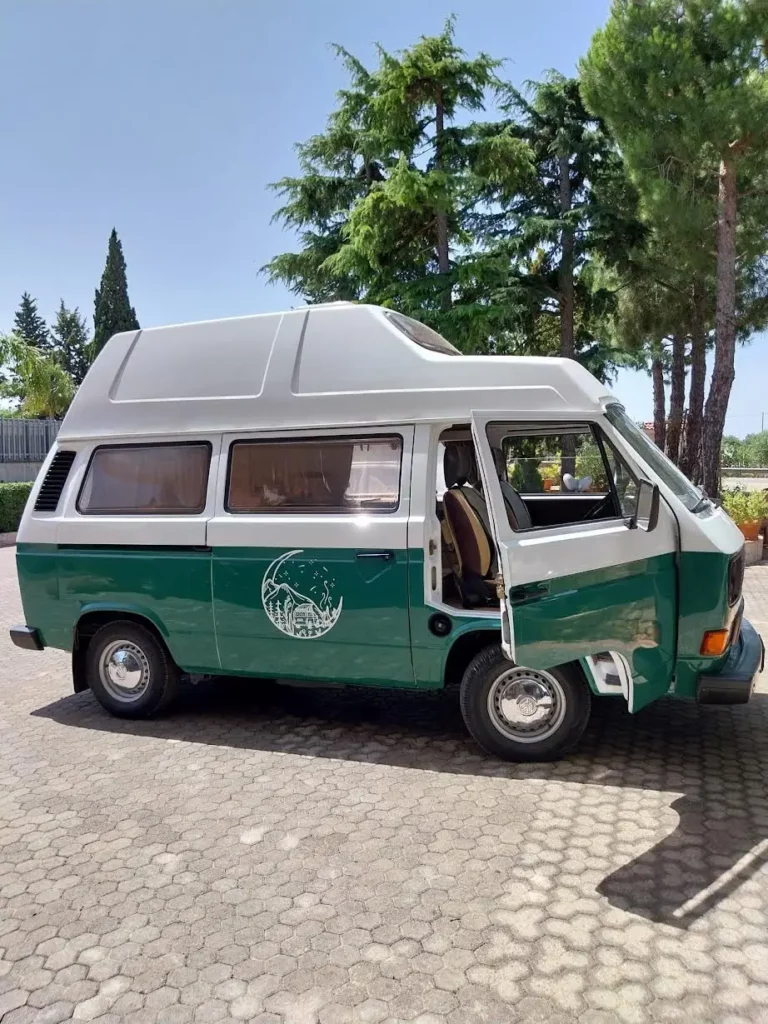
The T3 introduced a more modern, boxy design while remaining the last Transporter generation to feature a rear-mounted engine.
Its interior offered significantly more space, while improved suspension and handling made driving more comfortable than ever.
Many enthusiasts still consider the T3 the perfect balance between classic Volkswagen charm and everyday practicality.
T4 (1990–2003): The Revolution
The T4 marked the biggest engineering change in the history of the Transporter.
For the first time, Volkswagen moved the engine to the front. This dramatically improved safety, driving dynamics, cabin space, and maintenance accessibility.
It was also the generation that gave birth to the modern Volkswagen California, and many vanlife enthusiasts still regard the T4 as the ideal blend of vintage character and modern reliability.
T5 (2003–2015): Entering the Modern Era
With the T5, the Transporter became a thoroughly modern vehicle.
Efficient diesel engines, advanced electronics, improved safety systems, and significantly higher-quality interiors made it equally suited to everyday driving and long-distance adventures.
T6 & T6.1 (2015–Present)
The latest generations remain faithful to the Transporter’s original DNA while incorporating today’s technology, including advanced driver assistance systems, modern infotainment, improved efficiency, and greater comfort.
The Volkswagen California continues to be one of the world’s most desirable compact campervans.
The 1960s and the Dream of Freedom
The Volkswagen Camper’s popularity exploded during the 1960s.
As society underwent profound cultural change, the little German van became the vehicle of choice for students, artists, musicians, and free-spirited travelers.
Its affordable price and easy camper conversions made it ideal for anyone seeking an alternative lifestyle. Even today, images of brightly painted VW buses parked at music festivals remain an enduring symbol of freedom.
Its Legacy in Modern Vanlife
Today, vanlife has become a global phenomenon.
Social media is filled with images of scenic road trips, ocean sunsets, and peaceful nights spent surrounded by nature.
Yet the Volkswagen Camper still holds a unique place in this movement.
Many of the values associated with modern vanlife were shaped by the culture that grew around these iconic vehicles:
freedom to travel anywhere
minimalist living
a close connection with nature
slow travel
seeking authentic experiences
Which Generation Is Right for You?
The answer depends on the kind of journey you’re looking for.
T1 & T2 — for pure vintage charm
T3 — for the perfect balance of heritage and practicality
T4 — for reliability and simplicity
T5 — for comfort and durability
T6 California — for the ultimate modern vanlife experience
From California to Puglia: Meet Calì, Cielo, and Faustino
That story continues here in Puglia.
From the whitewashed villages of the Itria Valley to the dramatic cliffs of the Adriatic coast and the golden beaches of Salento, traveling by campervan still offers the same sense of freedom that made the Volkswagen Bus legendary more than seventy years ago.
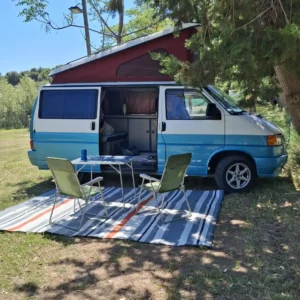
Calì is a 1991 Volkswagen T4—the generation that changed everything with its front-mounted engine while preserving the spirit of the originals.
Cielo is a 1995 T4—sharing the same character, with its own unique personality.
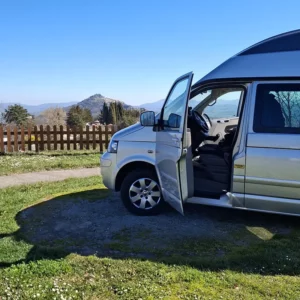
Faustino is a T5—more modern, yet driven by the very same philosophy of freedom.
Three generations of the Volkswagen California. One timeless way to travel.
That story continues in Puglia. Meet Calì, Cielo, and Faustino—our three Volkswagen California campervans, ready to take you wherever the road leads.