There are vehicles that transport people. And then there are vehicles that, over the years, come to represent a way of experiencing travel.
The Volkswagen California T4 certainly belongs to the second category.
Born in the early 1990s, the T4 represented a turning point in the history of the Transporter and the California. The front-mounted engine, front-wheel drive and new layout fundamentally changed the way the Volkswagen campervan was designed.
But its history does not fully explain its success. To understand why a T4 California can still win over enthusiasts and travellers today, you have to look beyond the technical aspects.
The T4 California and a New Idea of the Campervan
The Transporter T4 introduced a new architecture compared with previous generations. The most significant change was moving the engine to the front and adopting front-wheel drive.
But for those who wanted to travel, the real revolution was what this new configuration made possible inside: more space, a different distribution of the living areas and a greater sense of roominess.
The article already published on the history of the different generations explores this transition and identifies the T4 as one of the major turning points in the history of the Transporter.
Read more: Volkswagen Campervans: History, Generations and the Legacy That Keeps Travelling
Westfalia: When Every Inch Matters
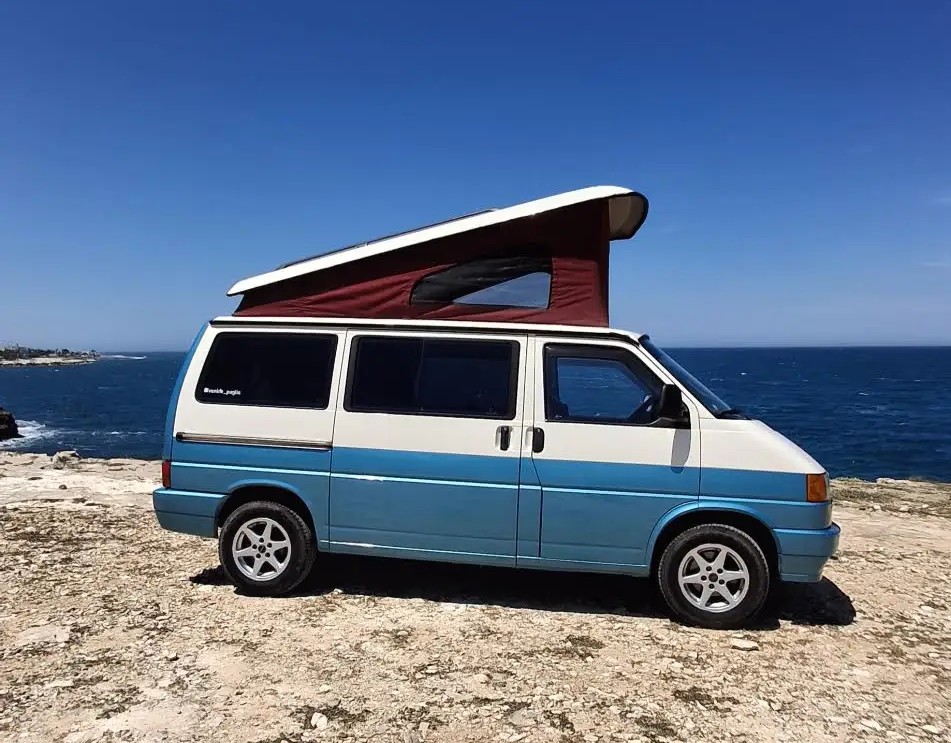
A fundamental part of the T4 California’s appeal is linked to its Westfalia conversion. A compact kitchen, refrigerator, storage compartments, water tanks, seats that convert into a bed and a pop-up roof were all arranged to make the most of necessarily limited space.
Nothing was accidental. Every element had a purpose. It is this philosophy that still makes the original interiors of T4 Californias particularly fascinating today.
The Format That Changed the Rules
The T4 California had a feature that is still difficult to replicate today: it managed to be a true campervan without always behaving like one.
It was compact enough to be used in everyday life. It could fit into an urban parking space, travel along a secondary road and stop in a small village. At the same time, once parked, it could transform into a small home on wheels.
Before the Word Vanlife Existed
Today, we call all of this vanlife. But the T4 belongs to an era before travel became a social media phenomenon.
The concept was much simpler: set off, sleep in the van, cook something, take a different road, and stay somewhere a little longer when a place deserved it.
The T4 California represents precisely this kind of freedom: not the spectacular freedom of perfect photographs, but the simpler freedom of not necessarily having to follow a plan.
The Charm of Something That Ages Well
Thirty years later, the T4 does not simply look like an old campervan. It has acquired a personality of its own.
Its design, interior, pop-up roof and Westfalia conversion details tell the story of a very specific era. And it is precisely this identity that makes it appealing even to people who are not necessarily car enthusiasts.
Why Is the T4 Still So Loved?
Probably because it brings together seemingly different qualities: simplicity, functionality, compact dimensions, character and freedom.
It does not offer the technology of a modern campervan. It does not try to. Its strength lies elsewhere: it invites you to slow down, to travel without turning the journey into a race, and to experience the places you visit rather than simply passing through them.
From the Volkswagen California to Puglia
This philosophy is particularly close to the way we understand VanLife.
Puglia is not simply a destination to reach: it is a region to explore slowly. Villages, countryside, sea, masserie and secondary roads are all part of the same experience.
A compact campervan such as the Volkswagen California T4 allows you to experience it at a different pace, leaving room for detours, stops and discovering the local area.
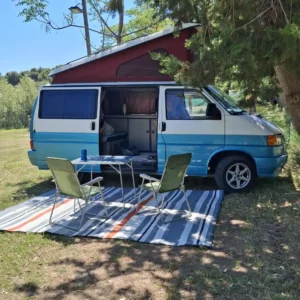
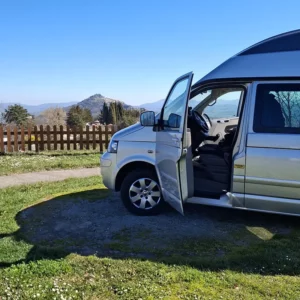
This is also why, in the VanLife Puglia fleet, we have chosen to keep two Volkswagen California T4s: Calì and Cielo, two vintage campervans that still preserve the original spirit of the California.
If you want to explore the complete evolution of the model, from the Transporter through the different California generations, also read: